

- Home /
- E900 Wheel Balancer Machine: How It Works and Why It Matters
E900 Wheel Balancer Machine: How It Works and Why It Matters
Table of Contents
If you’ve ever trained a new technician on a balancer, you know how it usually goes.
You explain static versus dynamic imbalance. You walk through measurements. You remind them where weights go. Then you double-check their first few jobs to make sure nothing leaves the bay with a vibration.
Now imagine handing that same job to someone who’s never balanced a wheel before—and within minutes, they can measure, spin, and correctly place weights with confidence.
That’s exactly what we demonstrated live at SEMA 2025 with the E900 Wheel Balancer machine.
This post isn’t about hype. It’s about understanding how the E900 works, what makes it different from older wheel balancing machines, and why that matters for independent shops and multi-outlet operations focused on consistency and efficiency.
How a Wheel Balancer Works (And Where Shops Lose Time)
Before we talk specifically about the E900 Wheel Balancer machine, let’s ground this in the basics.
A wheel balancer spins a mounted wheel and tire assembly at speed. Internal sensors measure vibration and identify where weight imbalances exist. The system calculates:
- The amount of corrective weight needed
- The location on the inner (inboard) and outer (outboard) planes
- Whether the imbalance is static, dynamic, or both
From there, the technician applies counterweights and performs a check spin to confirm the correction.
That’s the theory.
In real shops, time is lost when:
- Measurements are entered incorrectly
- Techs guess at weight placement
- Multiple re-spins are required
- The interface isn’t clear
Even small inefficiencies add up across 10–20 balance jobs per day.
The goal of modern balancing equipment should be simple: reduce friction in the process.
Step-by-Step: How the E900 Wheel Balancer Machine Guides the Technician
At SEMA, we walked a first-time user through the E900 Wheel Balancer machine. Here’s what that process looked like.
-
Select the Weight Type
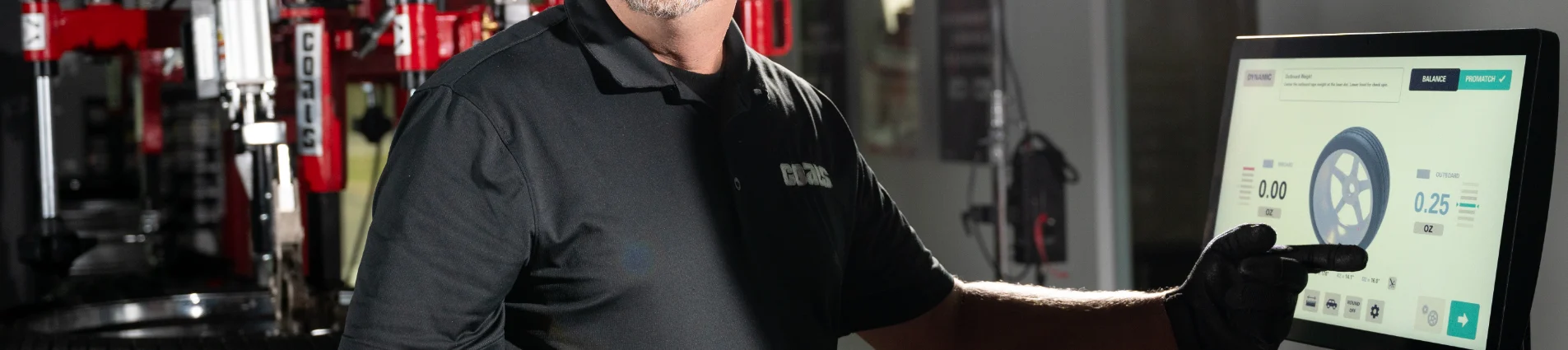
The technician selects clip weights or tape weights directly on the touchscreen.
No complicated menus. Just a clear selection that defines how the balance will be performed.
This matters because the machine must know the correction style before calculating placement.
-
Measure the Wheel Dimensions
Every wheel balancer needs three key inputs:
- Diameter
- Width
- Offset
On the E900, measurement is guided visually. The screen shows exactly where to position the measuring device. The system confirms the input as it’s captured.
This reduces one of the most common sources of balancing error: incorrect dimension entry.
When dimensions are wrong, everything downstream is wrong.
-
Close the Hood and Spin
Once the measurements are confirmed, the technician closes the hood and the E900 Wheel Balancer machine performs the spin cycle.
During this spin:
- Sensors detect vibration
- The machine calculates imbalance
- Required weight and location are determined
The technician doesn’t need to interpret raw data. The system presents the answer clearly.
-
Laser-Guided Weight Placement
This is where clarity really shows up.
After the spin, the E900 indicates:
- The exact amount of weight required
- The exact position to apply it
A laser marker identifies where to place the weight on the rim.
Instead of estimating or eyeballing placement, the technician follows a visible guide.
For shops focused on reducing rework, this is a big deal.
-
Re-Spin and Confirm Zero
After weights are applied, a check spin verifies correction.
A properly balanced wheel should show zero on both planes. If additional adjustment is needed, the E900 indicates it.
The process is direct. No guesswork.
Why Ease of Use Isn’t Just a “Nice to Have”
Independent shop owners are cautious with equipment purchases for good reason. Every machine on your floor must:
- Be reliable
- Be easy to train on
- Produce consistent results
- Avoid unnecessary downtime
A complicated balancer doesn’t just slow down one technician—it slows down the entire workflow.
The E900 Wheel Balancer machine was designed around a simple idea: guide the technician through the process instead of assuming they already know it.
That approach supports:
- Faster onboarding of new hires
- Easier cross-training
- Reduced supervision time
- Lower risk of customer comebacks
When someone who has never balanced a wheel can describe the process accurately after one demonstration, the interface is doing its job.
Standardization for Multi-Outlet Operations
If you manage multiple locations, consistency becomes even more important.
Multi-outlet owners prioritize scalability and standardization when selecting equipment . If every store runs different balancers, you get:
- Different training requirements
- Different service outcomes
- Different troubleshooting processes
Standardizing on the E900 Wheel Balancer machine across locations helps ensure:
- Technicians can transfer between stores easily
- Training materials stay consistent
- Performance metrics are comparable
- Service support is streamlined
That’s the operational advantage of choosing equipment that’s both intuitive and durable.
Where the E900 Fits in the Coats Portfolio
The E900 Wheel Balancer machine aligns with the Coats Pro Series philosophy: measurement and diagnostic systems built to improve ride quality and safety while remaining straightforward to use .
In practical terms, that means:
- Clear diagnostic output
- Interfaces designed around technicians
- Systems built for serviceability
For shops building out a full-service wheel department, that also means pairing balancing systems with tire changers and lifts designed for durability and high duty cycles .
The goal isn’t just to balance wheels. It’s to build a shop environment where the equipment works together without slowing your people down.
The Real-World Impact of Better Balancing
Balancing isn’t just a technical step—it directly affects:
- Ride comfort
- Tire life
- Suspension wear
- Fuel efficiency
More importantly, it affects your reputation.
When a vehicle leaves your shop with a steering wheel vibration, that customer comes back. When it leaves smooth and quiet, that customer tells someone else.
A wheel balancer should help eliminate vibration issues quickly and confidently. The E900 is built to make that process easier for technicians at every experience level.
What to Evaluate in Your Current Wheel Balancing Machine
If you’re assessing your current equipment, ask yourself:
- How long does it take to train a new technician on your balancer?
- How often do you see repeat spins due to placement errors?
- Are technicians confident using it without supervision?
- Is the interface clear and guided—or dependent on memory?
The E900 Wheel Balancer machine addresses these questions directly through guided operation, laser placement, and simplified measurement entry.
In a high-performing shop, equipment should support craftsmanship—not complicate it.
Final Takeaway
The demonstration at SEMA proved something important: balancing a wheel doesn’t have to be complicated to be precise.
The E900 Wheel Balancer machine combines core balancing fundamentals with guided, technician-focused design. For independent shops, that means easier training and fewer errors. For multi-location operators, it means consistency and scalability.
At the end of the day, wheel balancing should be accurate, repeatable, and straightforward.
When your balancer works the way your shop works—clear, efficient, and dependable—you keep people moving and technology turning.
That’s what high-performing shops are built on.
US Headquarters
1601 J.P. Hennessy Drive
LaVergne, TN 37086 USA
Sales Inquiries: 855-876-3864
Customer Service: 800-688-6359
Fax: 615-747-2952
Canada
2430 Lucknow Drive, Unit 9
Mississauga, Ontario
L5S 1V3 Canada
Phone: (877) 801-1405
Fax: (905) 672-9455
Related Articles
RC Tire Changer Guide: Is the Coats RC-55 Right for Your Shop?
E900 Balancer Safety: Practical Habits That Protect Your Shop
Balancer Accessories That Help Shops Get It Right the First Time
Never miss out on new product releases! Subscribe to our newsletter.
"(Required)" indicates required fields
By pressing subscribe, you agree to receive updates and promotional materials from Coats.*
© 2026 Coats. All rights reserved.